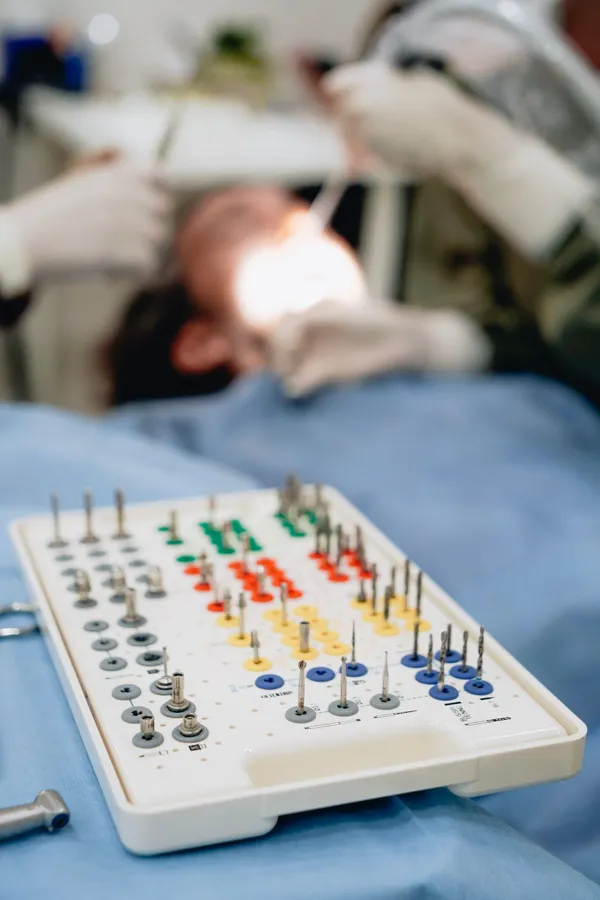
All-on-4 is, for many patients, the most financially transformative procedure in dental tourism. A full upper and lower arch restoration — effectively two complete sets of teeth supported by eight implants — costs £24,000–£36,000 or more in UK private practice. In Turkey or Hungary, the same procedure costs £7,000–£12,000. For patients who have been told they need extensive reconstruction but cannot afford UK prices, this cost differential is not marginal — it is the difference between having functional teeth and not. The procedure is legitimate and clinically well-evidenced. But the specifics of how it is delivered in a dental tourism context require careful scrutiny.
What All-on-4 Actually Involves
The All-on-4 protocol, developed by Portuguese implantologist Paulo Maló in the 1990s, uses four dental implants to support a full arch of teeth. Two implants are placed vertically at the front of the arch, and two are placed at an angle (typically 30–45 degrees) toward the rear, using existing bone and avoiding the need for sinus lifts in many patients. This angled placement is what makes All-on-4 particularly useful for patients with significant bone loss — it maximises contact with available bone without requiring bone grafting in most cases.
The procedure typically involves: pre-surgical assessment including CBCT scanning and digital planning; any necessary extractions; implant placement; and attachment of a temporary prosthesis. The temporary prosthesis is a critical component — it allows function and aesthetics during the osseointegration period while protecting the implants from excessive load. After osseointegration (3–6 months), the temporary prosthesis is replaced with the final restoration.
All-on-6 is a variation that uses six implants per arch, providing additional stability and distribution of load. It is typically recommended for patients who want additional redundancy or who have bone geometry that benefits from six placement sites.
The One-Trip vs Two-Trip Question
This is the central practical question for dental tourists considering All-on-4. The conventional protocol requires two trips: one for implant placement and temporary prosthesis fitting (typically 5–7 days), and one return visit approximately three to six months later for the final permanent prosthesis.
Some clinics offer "teeth in a day" or single-trip All-on-4, where the permanent (or high-quality temporary) prosthesis is fitted at the time of implant placement. This is clinically acceptable in carefully selected patients but represents a significant compression of the biological process — the permanent prosthesis is being loaded onto implants before osseointegration is confirmed.
The honest assessment: for patients who are prepared to make two trips, the conventional two-trip protocol is clinically safer and should be preferred for complex cases. For patients who can only make a single trip, the temporary prosthesis approach — receiving a good-quality acrylic temporary at placement and returning for the permanent restoration — is a reasonable compromise that balances clinical safety with practical constraints. Be sceptical of clinics that offer a single-trip permanent ceramic prosthesis without a compelling clinical explanation.
Cost Comparison — All-on-4 Abroad 2025
| Country | All-on-4 per arch | Full mouth (both arches) | Saving vs UK |
|---|---|---|---|
| UK (private) | £12,000–£18,000 | £24,000–£36,000 | — |
| Turkey | £3,500–£6,000 | £7,000–£12,000 | ~65% |
| Hungary | £5,000–£8,000 | £10,000–£16,000 | ~55% |
| Albania | £2,500–£4,500 | £5,000–£9,000 | ~75% |
| Poland | £4,500–£7,000 | £9,000–£14,000 | ~60% |
| Mexico | £3,000–£5,500 | £6,000–£11,000 | ~65% |
| Colombia | £3,000–£5,500 | £6,000–£11,000 | ~65% |
Key Questions to Ask Any All-on-4 Provider
What implant brand will be used? Can you provide the implant reference number in writing?
Will I receive a temporary prosthesis at placement, or a permanent one? If permanent, what is the clinical basis for this choice given my specific bone assessment?
How many All-on-4 cases does this clinic complete per year?
What happens if one of the four implants fails to integrate — what is the contingency?
Is the final prosthesis made in-house or at an external laboratory? Can I see examples of completed cases?
What is covered by the guarantee, and how are warranty claims managed from outside the country?

Get anonymous All-on-4 quotes from verified clinics
Compare prices from multiple verified clinics across Turkey, Hungary, Albania and other destinations without sharing your details.